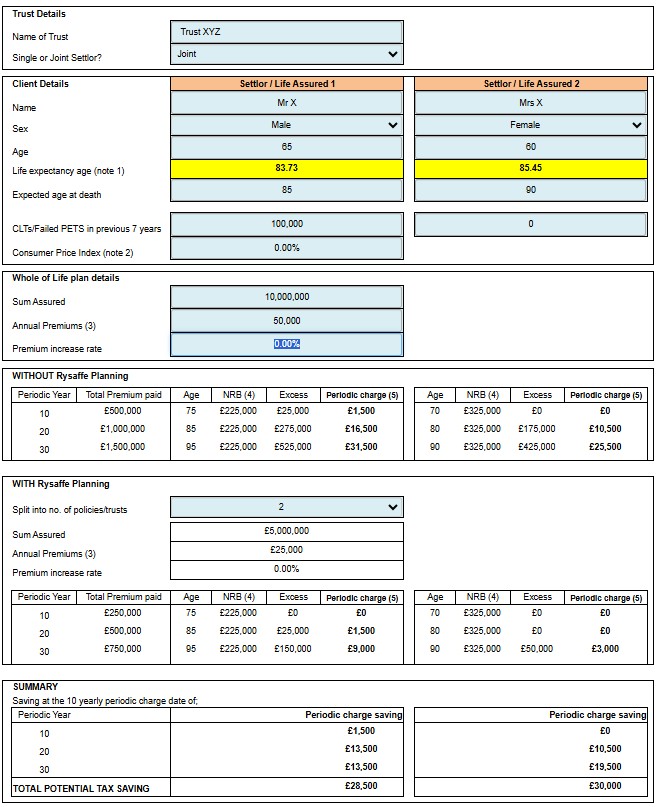
The objective of the Rysaffe Trust Calculator is to illustrate how the Inheritance Tax (IHT) periodic charge at a Whole of Life (WoL) trust’s 10-year anniversary may be reduced by dividing the plan between multiple separate trusts established on different dates, rather than placing the entire plan into a single trust.
Background
Investment plans, including WoL plans, held under a discretionary trust are subject to the relevant property regime for IHT purposes. As a result, the trust may be assessed for IHT at each 10-year anniversary, with a periodic charge of up to 6% applying to the value of trust assets that exceed the available IHT Nil Rate Band (NRB).
Where a trust is created by joint settlors, each settlor’s share is generally treated as a separate settlement and benefits from its own available NRB.
Valuation of Whole of Life Plans
For periodic charge purposes, the value of a Whole of Life plan is normally the greater of:
- The policy’s open market value or surrender value; and
- The total premiums paid to date.
If the life assured is in serious ill health at the 10-year anniversary, the market value of the policy may significantly exceed its surrender value.
For larger Whole of Life plans, a periodic charge can arise if the cumulative premiums paid at a 10-year anniversary exceed the available NRB.
The Rysaffe Principle
Instead of establishing one large discretionary trust, consideration can be given to creating a number of separate trusts on different days.
Following the principles established in Rysaffe Trustee Co (CI) v IRC, each trust may benefit from its own NRB when calculating any periodic charge. This can substantially reduce, or potentially eliminate, the 10-year charge that would otherwise apply to a single larger trust.
An additional benefit is that, where there was no periodic charge at the most recent 10-year anniversary, there will generally be no exit charge when the settlor dies and the policy proceeds are paid from the trust.
When Might This Be Relevant?
Rysaffe planning is generally unnecessary where the premiums are relatively modest. The key consideration is whether the cumulative premiums paid into the trust are likely to exceed the available NRB during the settlor’s lifetime.
A useful starting point is to compare the expected cumulative premiums, based on the settlor’s average life expectancy, with the projected NRB available at future 10-year anniversaries.
The Rysaffe Trust Calculator provides an indication of whether establishing multiple trusts may be beneficial in reducing potential IHT periodic and exit charges.